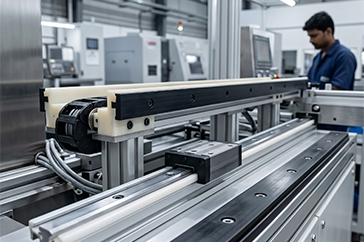
Your component passed inspection today. Will it survive the environment it ships into?

A Part Can Pass Every Dimension on the Drawing and Still Fail Early

Corrosion is one of the most common, and most avoidable causes of industrial part failure.

It is also one of the most misunderstood. Buyers and engineers focus on dimensional accuracy, surface finish, and mechanical strength.

The material grade often defaults to whatever was used last, or whatever the machining manufacturer quotes as standard.

That default is where early failures begin.

A precision machined component can hold every tolerance on the drawing, pass First Article Inspection, and still fail in service within months not because of a machining defect, but because the alloy was not matched to the environment it operates in.

Corrosion doesn’t announce itself at incoming inspection.

It shows up in the field, in maintenance costs, in unplanned downtime, and in premature replacement cycles.

For buyers sourcing CNC machined components, brass fittings, stainless steel machined components, or special alloy parts for industrial, marine, chemical, or fluid handling applications, material selection is not a secondary decision.

It is as critical as the drawing specification itself.

The Three Failure Mechanisms That Drive Most Corrosion-Related Part Failures

Corrosion is not one problem.

It is a category of problems, each driven by a specific service condition.

The three mechanisms that account for the majority of corrosion-related failures in precision machined components are pitting corrosion, dezincification, and galvanic corrosion.

Each requires a different material response.

1. Pitting Corrosion – Chlorides and Marine Environments

Pitting corrosion occurs when localised breakdown of a metal’s passive oxide layer allows aggressive ions, most commonly chlorides, to attack the base metal beneath.

Standard 304 stainless steel is susceptible to this mechanism in marine, coastal, and chloride-exposed environments.

The surface appears intact while corrosion progresses from small pits inward.

This is why 316 and 316L stainless steel gets specified over 304 for marine hardware, offshore components, chemical processing equipment, and coastal industrial applications.

The addition of molybdenum in 316/316L significantly increases resistance to chloride-induced pitting.

For precision machined stainless components operating near salt water, washdown environments, or chloride-bearing process fluids, 316L is not an upgrade, it is the correct base specification.

For the most aggressive marine and chemical environments, higher-grade alloys including Duplex 2205, Super Duplex 2507, Hastelloy C276, and Monel 400 provide further resistance where 316L reaches its limit.

Special alloy machining for these grades requires adjusted cutting parameters, tooling selection, and process controls not every CNC machining manufacturer has developed the process discipline these materials demand.

2. Dezincification – High-Zinc Brass in Aggressive Water

Dezincification is a form of selective leaching specific to brass alloys with high zinc content.

In aggressive water conditions, soft water, slightly acidic water, elevated temperatures, or stagnant flow, zinc selectively leaches from the brass matrix, leaving a porous, weakened copper structure that retains the original shape but has lost most of its mechanical strength.

Standard brass alloys including CW617N (commonly used for valves, fittings, and plumbing components) are susceptible to dezincification in these conditions.

The visible appearance of the component gives no warning, the failure is internal and progressive.

The solution is alloy selection. DZR brass (Dezincification Resistant) and naval brass grades including C46400 and C48600 are engineered specifically to resist this mechanism.

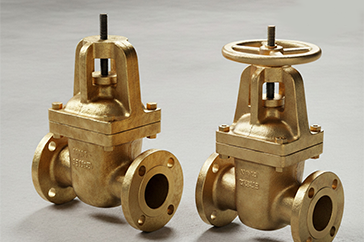
For brass machined components, brass fittings, and brass valve parts used in water contact applications, plumbing systems, marine environments, or industrial fluid handling,

DZR and naval brass grades should be specified wherever dezincification risk exists.

For water contact applications in European markets, the EU Drinking Water Directive positive list further defines which alloy compositions are permitted, CW509L and CW510L are among the approved low-lead grades that also carry improved dezincification resistance characteristics.

3. Galvanic Corrosion – Dissimilar Metals in Contact

Galvanic corrosion occurs when two dissimilar metals are in electrical contact in the presence of an electrolyte, water, moisture, or a process fluid.

The less noble metal in the pairing acts as an anode and corrodes preferentially.

The failure doesn’t occur evenly across the component surface, it concentrates at the junction between the two materials.

This is a critical consideration for assemblies that combine precision machined components in different materials: brass fittings connected to aluminium housings, stainless steel fasteners through carbon steel flanges, bronze bushings in steel bores.

The joint corrodes, not the surfaces, and the failure appears at the interface long before either material would fail in isolation.

Managing galvanic corrosion requires either pairing materials that are close together on the galvanic series, introducing an isolating barrier between dissimilar metals, specifying appropriate surface treatments, or redesigning the assembly to eliminate the dissimilar metal contact.

A machining manufacturer with genuine materials knowledge flags these risks at the DFM stage, before production begins.

Material Selection Is Matched to Service Condition, Not Defaulted

The common thread across all three failure mechanisms is the same: the wrong material grade, applied to the right drawing, produces a component that meets specification at inspection and fails in service.

Dimensional accuracy is necessary but not sufficient.

The alloy must be matched to what the component will actually experience, the fluid, the temperature, the environment, the adjacent materials.

The right grade and the right surface finish cut maintenance intervals, prevent early replacement, reduce unplanned downtime, and keep precision machined components in service for their designed life.

The wrong grade, even machined perfectly, doesn’t.

How Amarex Metals Works Approaches Material Selection

Amarex Metals Works machines precision components across 9 material families, brass and copper alloys, steel alloys, stainless steel, aluminium alloys, special alloys including Monel, Inconel, Hastelloy, Titanium and Duplex, engineering plastics, castings, forgings, and extrusions, supplying buyers across marine, valve, pipe fitting, instrumentation, chemical, electrical, and industrial applications globally.

Material selection at Amarex begins with the service condition, not the price list.

Where a drawing specifies an alloy that carries corrosion risk for the stated application, Amarex raises it before quoting, not after the first article fails.

Where compliance requirements apply, RoHS, REACH, or EU Drinking Water Directive positive list, they are confirmed at the quoting stage with the correct alloy grade specified from the start.

Every material lot is spectroscopically verified on incoming inspection against third-party test certificates from Government-approved NABL labs.

The alloy that was specified is the alloy that was machined, documented, traceable, and confirmed.

With manufacturing at Jamnagar and head office in Mumbai, Amarex supplies export-grade precision machined components to buyers in the USA, UK, Europe, and global markets across 14 industries.

Our quality management is ISO 9001:2015 certified at our Mumbai head office.

Good machining produces the part. The right material is what keeps it running.
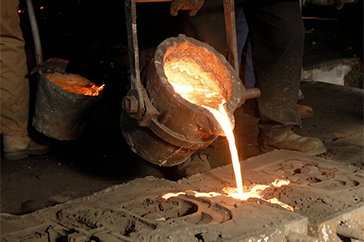
Sand Casting: The Oldest Metal Forming Process Still Dominating Heavy Industry

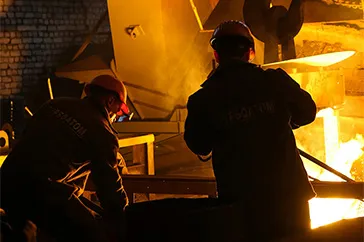
Sand casting is unforgiving. The metal doesn’t lie, every bad decision made upstream shows up in the casting.

No casting method has a wider range than sand casting metals, sizes, geometries, production volumes.

From a 1 kg brass valve body to a multi-tonne steel industrial housing, sand casting handles what other processes simply can’t.

It is the backbone of foundry manufacturing worldwide, and despite decades of newer, more sophisticated casting methods entering the market, sand casting remains the most widely used metal forming process in heavy industry.

This article explains exactly how sand casting works, where it fails, and what process control looks like when it’s done correctly.

What Is Sand Casting?

Sand casting is a metal forming process where a pattern, a replica of the finished component, is pressed into a sand-based moulding mixture to create a cavity.

Molten metal is poured into that cavity, allowed to solidify, and the sand mould is broken away to release the raw casting.

The process is suitable for virtually every castable metal grey cast iron, ductile iron, carbon steel, stainless steel, brass, bronze, aluminium alloys, and special alloys.

It accommodates components from a few hundred grams to several tonnes, and handles internal geometries through the use of core separate sand shapes placed inside the mould cavity before pouring.

No other casting method matches that combination of material range, size range, and geometric flexibility.

The Sand Casting Process Step by Step

Pattern pressed into sand → mould cavity formed The pattern made from wood, aluminium, or resin is placed in a moulding box and packed with a sand mixture.

Green sand (sand, clay, and water) is the most common. Chemically bonded sand is used for complex or large components requiring higher dimensional stability.

The pattern is withdrawn, leaving an exact negative cavity. Cores placed → internal geometry defined For components with internal passages, valve bodies, pump housings, pipe fittings, sand cores are placed inside the mould cavity before closing.

Cores define bores, ports, and internal channels that cannot be formed by the external pattern alone.

Gating system assembled → metal flow path established The sprue, runners, and gates the channels through which molten metal travels from the pouring cup into the cavity are cut or formed into the mould.

Risers reservoirs of liquid metal positioned above heavy sections are added to feed shrinkage as the casting solidifies.

Molten metal poured in → solidification begins Metal is poured at the correct temperature for the alloy.

Too hot excessive shrinkage, gas absorption, grain coarsening. Too cold misrun, cold shut, incomplete fill.

The metal flows through the gating system, fills the cavity, and begins solidifying from the mould walls inward.

Sand mould broken away → raw casting extracted Once solidified and cooled to a safe handling temperature, the mould is broken apart by shakeout releasing the casting.

Cores are removed from internal passages. The casting emerges rough, covered in sand and oxide scale.

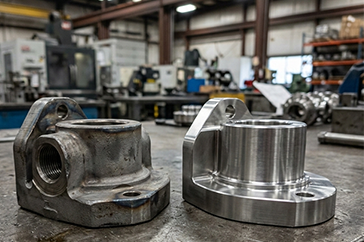
Shot blasted, gates removed → ready for CNC machining The casting is shot blasted to remove surface scale and sand.

Gates, runners, and risers are cut away. The parting line flash is ground smooth. The cleaned casting is inspected for surface defects before moving to CNC machining for final dimensional finishing.

Where Sand Castings Fail And Why

Sand casting defects are never random. Every one traces back to a specific engineering decision made before the metal was poured.

Shrinkage allowance miscalculated → casting undersized after cooling, critical dimensions out of tolerance Gating system poorly designed → turbulent metal flow, trapped gas, porosity throughout the casting wall Riser undersized or misplaced → insufficient feed metal, shrinkage voids in thick sections Core misaligned or poorly bonded → internal passage off-centre, core collapse during pouring Pouring temperature incorrect → misrun if too cold, excessive porosity and grain coarsening if too hot Sand mixture poorly prepared → mould wall erosion, sand inclusions embedded in the casting surface Solidification sequence uncontrolled → shrinkage voids form in heavy sections as metal contracts without liquid feed Each of these is a process control failure not a material failure, not a machine failure.

The foundry that controls these variables produces sound castings consistently.

The one that doesn’t produce scrap and passes the cost and delay to the buyer.

From Foundry to Final Inspection: Amarex Metals Works

Amarex Metals Works, a precision CNC machining and components manufacturer, sources sand cast components from verified foundry partners across Gujarat’s Rajkot manufacturing cluster, where alloy certification and process documentation are supply agreement requirements not afterthoughts.

Every casting is inspected on arrival. Every critical dimension is verified before machining. Every shipment leaves with ISO 9001:2015 certification, material test certificates, and full traceability from foundry to final inspection report.

10,000 Tonnes of Pressure. Milliseconds of Contact. One Perfectly Formed Component.

Steel doesn’t just bend, it has to be forced.

That’s the brutal simplicity at the heart of forging, one of the oldest and most uncompromising manufacturing processes in modern industry.

While casting pours molten metal into a mould and hopes for the best, and machining carves a shape away from a solid block, forging does something fundamentally different.

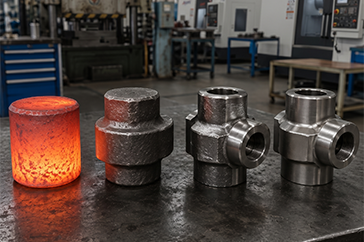
It takes a heated metal billet and compresses it under thousands of tonnes of pressure between precision-engineered dies, forcing the material to flow completely, obediently, into every contour of the cavity.

What comes out the other side isn’t just shaped. It’s transformed.

The Science Behind the Strength

When metal is worked under pressure at elevated temperatures, something remarkable happens at the microstructural level.

The internal grain structure of the material doesn’t just deform it realigns.

The grains flow with the shape of the part, wrapping around contours and following the geometry of the finished component rather than running in random directions as they would in a casting.

This grain alignment is everything. It’s the difference between a component that performs and one that merely exists.

Forged parts resist fatigue, handle impact loads, and tolerate cyclic stress in ways that cast alternatives simply cannot replicate.

Under repeated loading the kind that valves, pipe fittings, and locomotive components experience every day in service that aligned grain structure holds.

Castings develop internal porosity, shrinkage voids, and inconsistent density.

Forgings don’t.

This isn’t a marginal improvement. In critical applications, the difference between a forged component and a cast one can be the difference between a system that performs for decades and one that fails prematurely.

The Forging Sequence

Producing a forged component is a tightly controlled sequence of operations, where every step feeds into the next with precision.

It begins with the billet, a cut section of raw material prepared to an exact weight.

Not approximate. Exactly. Material volume directly determines how well the metal fills the die cavity, so a billet that’s even slightly off will produce flash in the wrong places or leave underfilled sections.

Weight control at this stage is non-negotiable.

The billet is then heated to a material-specific temperature.

Different alloys have different working windows too cold and the metal won’t flow, too hot and grain growth degrades properties. Getting that temperature right, and maintaining it consistently through to the press, is as much metallurgy as it is logistics.

At the press, the heated billet is placed between closed dies and compressed.

In that fraction of a second milliseconds of actual contact the metal fills the die cavity completely, the grain structure aligns, and the near-net shape of the finished component is formed.

The press force can reach 10,000 tonnes or beyond depending on the material and the part geometry.

Flash the thin fin of excess material that escapes at the die parting line is trimmed away in a separate operation.

The part then moves to heat treatment, where controlled heating and cooling cycles refine the microstructure further, relieving residual stresses and optimising mechanical properties for the intended application.

From there, it’s into the machine shop.

Forged blanks arrive close to final shape but still require CNC machining to achieve functional tolerances.

Sealing faces, thread forms, bore dimensions are machined to tight tolerances that the forging process alone can’t deliver.

Finally, inspection closes the loop: dimensional verification at the micron level, surface finish checks, and material certification ensure every component leaving the facility meets specification.

Where Forged Components Perform

The industries that rely on forged components are, almost without exception, the ones that cannot afford failure.

Oil and gas valves operate under extreme pressures in corrosive environments.

Pipe fittings in high-temperature process lines experience constant thermal cycling.

Automotive drivetrain components absorb shock loads repeatedly over hundreds of thousands of kilometres.

Locomotive parts run in continuous service under demanding mechanical conditions.

In all of these applications, the superior fatigue life and structural integrity of forgings justify their use.

Cast alternatives may be cheaper to produce, but over the lifetime of a system, the cost calculus shifts decisively in favour of forging fewer failures, less downtime, longer service intervals.

Built to Perform: Amarex Metals Works

Amarex Metals Works machines forged blanks across nine material families, including brass, steel, aluminium, Inconel, and a range of specialist alloys.

Operating under ISO 9001:2015 certification, Amarex Metals Works supplies industrial buyers across the USA, UK, and Europe delivering components that meet the dimensional, mechanical, and material requirements of demanding end-use environments.

Forging isn’t an easy process. It’s the right one.

Why Cast-Then-Machine Beats Machining-From-Bar for Certain Brass Parts

The Bar Stock Decision Is Costing You More Than You Think

When a buyer sends a drawing to a brass components manufacturer, the default assumption is often the same: machine it from bar stock.

Bar stock is available, familiar, and easy to quote. No tooling investment. No lead time for castings. Just load the bar, run the program, ship the parts.

For simple, small-diameter, low-complexity brass components that logic holds.

But for a significant category of brass parts (valve bodies, pump housings, complex fittings, multi-port manifolds, thick-section connectors), machining from bar stock is the wrong process.

It costs more, wastes more material, takes longer, and in some cases produces a structurally inferior component.

This article explains exactly when and why cast-then-machine beats machining-from-bar for brass parts and what that means for buyers sourcing brass fittings, brass machined components, and precision brass parts at volume.

The Core Problem With Machining Complex Brass Parts From Bar

Bar stock machining works by removing material from a solid billet until the finished shape remains.

For a simple turned component, a ferrule, a compression fitting body, a straight connector, the amount of material removed is manageable.

The process is efficient. But consider a valve body with multiple ports, a thick central boss, internal passages, and a complex external geometry.

To machine that from bar stock:  

  • The bar diameter must be large enough to encompass the largest cross-section of the part
  • Every feature that isn’t the finished shape must be cut away as chips on the floor
  • Machine cycle time scales with the volume of material removed, not the volume of the finished part
  • Tool wear is higher when removing large volumes of brass continuously
  • The finished component may have interrupted grain structure wherever significant material was removed

On a complex brass part, material removal rates of 60–75% are not uncommon when machining from a bar.

That means for every kilogram of finished component, 2.5 to 4 kg of brass bar was purchased, loaded, and turned into chips.

At current brass prices, that waste is not trivial and it compounds across a production run.

Why Casting First Changes the Economics Entirely

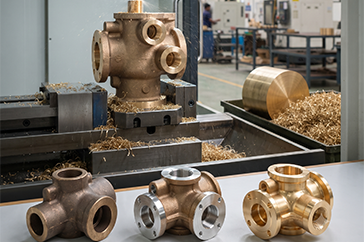
Brass casting whether sand casting, shell moulding or investment casting produces a near-net-shape blank that already contains the approximate geometry of the finished part.

The casting doesn’t need to become the part from scratch. It just needs to be finished.

The economics shift immediately:

Material utilisation improves dramatically. A cast blank for a complex valve body might require only 15-25% material removal during CNC machining versus 60-75% from the bar.

Less brass purchased. Less brass wasted. Lower raw material cost per finished component. Machine cycle time drops.

CNC machining time is directly proportional to the volume of material removed and the number of features generated from scratch.

A cast blank arrives with bosses, ports, and wall sections already formed.

The CNC machine refines and finishes; it doesn’t generate from nothing.

Cycle times on complex parts can be reduced by 40-60% compared to machining from a bar.

Complex internal geometry becomes feasible. Internal passages, non-concentric ports, and undercut features that would require multiple setups and special tooling to machine from bar can be cast into the blank as standard.

A brass casting with a pre-formed internal passage eliminates boring operations entirely on that feature.

Tool wear reduces. Continuous heavy cuts through large brass billets accelerate tool wear.

Lighter finishing passes on a cast blank extend tool life significantly reducing tooling cost per component across a production run.

When Cast-Then-Machine Is the Right Process

The decision depends on specific part characteristics:   Cast-then-machine is the right choice when:

  • Wall sections vary significantly across the part: thick bosses, thin walls, internal voids
  • The part has multiple ports, passages, or complex internal geometry
  • The finished component weighs more than approximately 300-400 grams
  • Production volume justifies casting tooling investment (typically 500+ pieces per run)
  • Material cost is a significant proportion of total component cost

 Machining from bar remains correct when:

  • The part is simple and rotationally symmetric, such as a straight turned component
  • The finished diameter is close to standard bar stock sizes, so material removal is minimal
  • Volume is too low to justify casting tooling
  • Lead time requirements don’t allow for casting procurement

The Brass Alloys Used in Cast-Then-Machine Components

 Not all brass alloys are suitable for casting. The alloy selection for a cast-then-machine component must consider both castability and machinability:  

  • C85500 / LG2 Gunmetal – excellent castability, good corrosion resistance, widely used for valve bodies and pump components
  • C86300 Manganese Bronze – high strength cast brass for load-bearing applications
  • C93200 / SAE 660 Bronze – centrifugal casting for bearing bushings and wear components
  • CW510L / CW509L – low-lead cast brass grades compliant with EU Drinking Water Directive positive lists for water contact fittings
  • C83600 good castability with balanced strength and corrosion resistance, commonly used for valves, flanges, and plumbing fittings
  • C84400 cost-effective casting alloy with good pressure tightness, used for low-pressure valves, pipe fittings, and general plumbing components

Alloy selection at the casting stage directly affects machinability, surface finish, and dimensional stability of the finished component.

A brass fittings manufacturer with genuine casting knowledge specifies the alloy to the application, not to what’s cheapest or most available.

How Amarex Metals Works Delivers Cast-Then-Machined Brass Components

Amarex Metals Works operates at the intersection of casting sourcing and precision CNC machining, which is exactly what cast-then-machine brass components require.

With manufacturing at Jamnagar, Amarex works with sand cast and shell moulded brass blanks.

Investment cast and die cast blanks are also within our scope. Every incoming casting is inspected against third-party test certificates from Government-approved NABL labs and spectroscopically verified before entering the CNC machining workflow.

Cast blanks are then CNC turned, VMC milled, bored, threaded and surface treated to final dimensional tolerances, producing finished brass machined components that meet export-grade specifications for buyers in the USA, UK, and Europe.

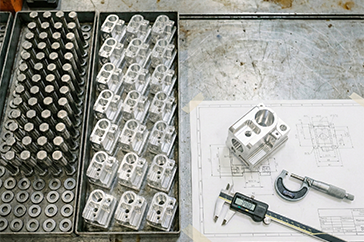
Final inspection uses VMM micron-level measurement systems.

Every shipment carries material documentation and, where required, RoHS and REACH compliance declarations.

For buyers sourcing complex brass fittings, valve bodies, pump components or multi-port manifolds, the cast-then-machine route delivers better economics, better cycle time, and better material utilisation than bar stock machining.

Amarex Metals Works is built to deliver that route, end to end.

Off-the-Shelf or Made-to-Order, the Right Choice Can Shape Performance and Cost.

Choosing between standard and custom metal parts depends on application needs, budget, and timelines.

Standard Parts

  • Readily available
  • Lower cost due to mass production
  • Proven designs and specifications
  • Faster delivery

Limitation: May not perfectly fit unique design or performance demands.

A catalogue knob will not match a lamp range’s profile; turned wooden components made to your sample will.

Custom Parts

  • Designed for specific applications
  • Optimized fit, strength, and function
  • Greater flexibility in materials and dimensions – a bore held to an H7 fit on machined bushes, for example

Trade-off: Higher cost and longer lead times.

Balancing Performance, Speed, and Budget

While standard components suit general applications, custom parts improve efficiency and reliability in specialized systems. The decision often comes down to balancing performance requirements with production speed and budget.

Standard and Custom Components From Amarex Metals

Amarex Metals supports both standard and custom precision components – from made-to-order automotive components to bushes machined to your drawing – helping industries choose solutions that align with technical needs and long-term value.

Metal Doesn’t Just Wear Out; Sometimes It Slowly Reacts With the Air Around It.

Oxidation resistance is a metal’s ability to withstand chemical reactions with oxygen, especially at elevated temperatures. When metals oxidize, they form surface oxides that can weaken the material, reduce conductivity, and affect appearance. In industrial applications, this can lead to scaling, corrosion, and reduced component life.

Factors Influencing Oxidation Resistance

  • Alloy composition (chromium, nickel, and aluminum improve resistance)
  • Operating temperature
  • Surface finish and coatings
  • Environmental exposure

Protective Oxide Layers and Material Selection

Some alloys form protective oxide layers that slow further reaction, while others degrade quickly without protection. Choosing the right material and finishing process is critical for long-term performance in harsh environments – and in seawater or acid service, that is usually when Monel or Inconel earns its cost over brass.

Material and Finishing Standards at Amarex Metals

Amarex Metals manufactures precision brass and copper components with attention to material selection and finishing standards. Because durability starts with resistance at the surface.

Two Valves May Look Similar, but Their Strength Tells a Different Story.

How Forged and Cast Valves Are Made

Forged valves are formed by compressing solid steel under extreme pressure, creating a dense, aligned grain structure that delivers superior strength and durability. Cast valves, on the other hand, are made by pouring molten steel into molds, allowing greater design flexibility and cost efficiency.

Where Each Valve Type Performs Best

Where pressure, temperature, and long service life matter most, forged valves often perform better. Cast valves still play an important role in applications where complex shapes and moderate conditions are required. Our own pressure-part route is brass hot forging followed by CNC machining; steel forgings are bought in and machined.

Matching Manufacturing Methods to Performance

As a brass ball valve manufacturer that both casts and hot-forges brass, Amarex Metals chooses the route per part, because understanding how the method affects performance is what delivers components that match real-world demands.

In critical systems, the right choice isn’t about looks; it’s about reliability.

Behind Every Innovation Is a Component That Had to Be Cast Right

The global metal casting market is growing fast, fueled by demand in automotive, infrastructure, and high-performance industrial components. But beyond the numbers, one thing is clear: businesses today expect every machined casting to arrive stronger, cleaner and more precise than ever.

How Amarex Metals Responds to the Shift

At Amarex Metals, we see this shift as an opportunity to deliver even more value. Our focus remains simple:

  • Quality alloys that ensure durability and consistency
  • Reliable casting processes that minimize defects
  • Custom solutions for industries with zero-tolerance performance needs, from cast and machined valve bodies to railway bushings
  • A customer-first mindset to support fast-changing demands

Supporting the Growth of Global Casting Hubs

As India and the Asia-Pacific region emerge as global casting hubs, we are committed to meeting that momentum with capability and care.

The industry is evolving and we’re evolving with it.

Where Metal Meets Mastery

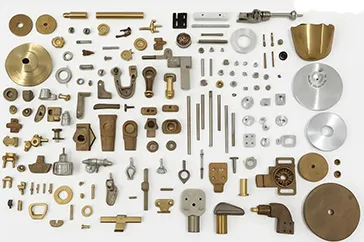
Non-ferrous metals like brass, copper, and aluminum have personalities of their own. At Amarex Metals, we don’t just work with them, we understand them.

Every alloy reacts differently, every process leaves a mark, and every detail counts.

Metallurgical Insight and Advanced Manufacturing

Our non-ferrous component manufacturing combines deep metallurgical insight with advanced CNC machining, precision casting, and meticulous finishing. The result? Components that perform flawlessly whether in electrical systems, automotive assemblies, or specialized industrial applications.

Precision, Care, and Confidence

But beyond the metal, it’s about trust, reliability, and craft. Every part we create tells a story of precision, care, and innovation. At Amarex, we don’t just deliver components; we deliver confidence.

Decorative Metal Parts, Engineered With Precision

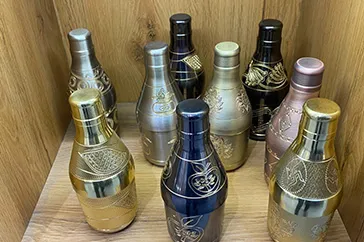
Behind every decorative bottle or artifact lies the same complexity as any engineered component. These parts demand CNC accuracy, controlled finishing, and repeatable quality at scale.

At Amarex Metals, we combine precision metal manufacturing with custom metal fabrication to produce decorative parts that meet global export standards.

Decorative Metal Manufacturing Capabilities

  • High-precision CNC machining for uniform shapes and detailed engravings
  • Custom tooling & fabrication to deliver client-specific requirements
  • Advanced polishing, plating & coatings for durable finishes
  • End-to-end quality control to ensure consistency in bulk production

Ready for International Markets

This approach makes our decorative metal parts not only visually striking but also precise as per customer drawings, reliable, scalable, and ready for international markets.

If you’re looking for decorative parts that combine precision, scale, and reliability Amarex Metals is built for that.

Get a Quote