
What Separates a Reliable Overseas Machine Shop From One That Isn’t

The Quote Looks Right. But Is the Supplier?

Sourcing precision components from an overseas machining manufacturer offers real advantages: competitive pricing, access to specialised manufacturing capability, and supply chain diversification.

But a wrong supplier decision doesn’t show up in the quote.

It shows up three months later, in a rejected batch, a missed production deadline, or a quality escape that reaches your end customer.

Buyers across the USA, UK, and Europe are increasingly qualifying CNC manufacturers in India particularly from precision manufacturing clusters like Jamnagar and Rajkot as primary suppliers, not backup options.

The capability is there.

The question is which precision machining companies are actually built to deliver at export grade, and which ones only appear to be.

The difference shows up quickly, across six areas that matter before a first purchase order is placed.

1. Quality Certification – and What It Actually Covers

ISO 9001:2015 certification is the baseline for any serious precision components manufacturer.

A certificate on a website means nothing without verification, the issuing body, the registration number, and the scope all need to be checked against the certifying agency’s public registry.

The scope is what most buyers miss.

An ISO certificate issued for general engineering may not cover the specific processes being bought: CNC turning, VMC milling, surface treatment, or special alloy machining.

The scope defines what the quality system actually governs and a supplier whose certificate doesn’t cover the relevant processes is not, in practice, a certified supplier for those processes.

2. Capability Statement, Not Just a Product Catalogue

A product catalogue shows what a supplier has made before.

What matters is what they can control: machine types, axis count, tolerance capability, material range, inspection equipment, and secondary process capability.

The strongest precision machine shops answer technical questions immediately and in detail tightest repeatable tolerance, inspection equipment in use, whether surface treatment is in-house.

Suppliers who respond to specific technical questions with generic brochures are showing you their ceiling before the first order is placed.

3. Material Traceability Documentation

Every precision machined component starts with raw material.

How a supplier verifies that material and what documentation they provide with each shipment is one of the clearest indicators of operational discipline.

The answer from a credible supplier includes: third-party test certificates from a Government-approved NABL lab, incoming inspection records, and spectroscopic verification of chemical composition.

For buyers sourcing brass components, CNC turned parts, or special alloy machined components, a machining manufacturer who cannot provide material traceability documentation cannot guarantee what they’re machining or shipping.

Alloy substitution is one of the most common quality failures in offshore supply chains and it is invisible without traceability.

4. First Article Inspection Reports

Before committing to production volume, the standard practice among serious precision machining manufacturers globally is a sample order with a full First Article Inspection (FAI) report.

The FAI documents every critical dimension on the drawing: measured results against nominal values, with tolerances clearly shown, produced using calibrated inspection equipment.

A supplier who provides this without being asked is demonstrating process confidence.

A supplier who resists providing one is demonstrating the opposite.

5. Export Compliance Posture

For buyers in the USA, UK, and Europe, RoHS and REACH compliance declarations, certificates of origin, and full export documentation are not optional extras; they are part of the shipment.

A machining manufacturer with genuine export experience has these ready at the quoting stage.

One without that experience will tell you they can arrange it after the order is confirmed.

The correct question is not whether a supplier can provide compliance documentation.

It is whether they do so as standard, without being chased.

6. Communication and Response Quality

How a precision machining manufacturer communicates before the first order is a direct indicator of how they will communicate when something goes wrong during production.

Response time, technical accuracy, and willingness to engage with specific questions about processes all reveal operational maturity in a way that a capability brochure cannot.

How Amarex Metals Works Performs Across All Six

Every point on this list is something Amarex Metals Works addresses as standard practice not on request, and not after the first order has been placed.

ISO 9001:2015 certification is held at our Mumbai head office, covering documented quality procedures across CNC turning, VMC milling, and precision engineering services.

Material traceability runs from incoming inspection to finished component: every material lot is spectroscopically verified on arrival, backed by third-party test certificates from Government-approved NABL labs.

First Article Inspection reports are produced on every new job using VMM micron-level measurement systems.

RoHS and REACH compliance documentation is confirmed at the quoting stage for buyers in the USA, UK, and European markets.

With manufacturing at Jamnagar at the centre of India’s precision manufacturing export belt and head office in Mumbai, Amarex supplies precision machined components across brass, steel, aluminium, stainless, and special alloys to auto components manufacturers, valve and pipe fitting buyers, brass parts suppliers, electrical equipment builders, and marine hardware buyers across 14 industries globally.

The first purchase order with a new overseas supplier carries real risk.

Amarex Metals Works is built to reduce it with process documentation, inspection records, and export compliance that give buyers the confidence to convert a sample order into a long-term supply relationship.
Your component passed inspection today. Will it survive the environment it ships into?

A Part Can Pass Every Dimension on the Drawing and Still Fail Early

Corrosion is one of the most common, and most avoidable causes of industrial part failure.

It is also one of the most misunderstood. Buyers and engineers focus on dimensional accuracy, surface finish, and mechanical strength.

The material grade often defaults to whatever was used last, or whatever the machining manufacturer quotes as standard.

That default is where early failures begin.

A precision machined component can hold every tolerance on the drawing, pass First Article Inspection, and still fail in service within months not because of a machining defect, but because the alloy was not matched to the environment it operates in.

Corrosion doesn’t announce itself at incoming inspection.

It shows up in the field, in maintenance costs, in unplanned downtime, and in premature replacement cycles.

For buyers sourcing CNC machined components, brass fittings, stainless steel machined components, or special alloy parts for industrial, marine, chemical, or fluid handling applications, material selection is not a secondary decision.

It is as critical as the drawing specification itself.

The Three Failure Mechanisms That Drive Most Corrosion-Related Part Failures

Corrosion is not one problem.

It is a category of problems, each driven by a specific service condition.

The three mechanisms that account for the majority of corrosion-related failures in precision machined components are pitting corrosion, dezincification, and galvanic corrosion.

Each requires a different material response.

1. Pitting Corrosion – Chlorides and Marine Environments

Pitting corrosion occurs when localised breakdown of a metal’s passive oxide layer allows aggressive ions, most commonly chlorides, to attack the base metal beneath.

Standard 304 stainless steel is susceptible to this mechanism in marine, coastal, and chloride-exposed environments.

The surface appears intact while corrosion progresses from small pits inward.

This is why 316 and 316L stainless steel gets specified over 304 for marine hardware, offshore components, chemical processing equipment, and coastal industrial applications.

The addition of molybdenum in 316/316L significantly increases resistance to chloride-induced pitting.

For precision machined stainless components operating near salt water, washdown environments, or chloride-bearing process fluids, 316L is not an upgrade, it is the correct base specification.

For the most aggressive marine and chemical environments, higher-grade alloys including Duplex 2205, Super Duplex 2507, Hastelloy C276, and Monel 400 provide further resistance where 316L reaches its limit.

Special alloy machining for these grades requires adjusted cutting parameters, tooling selection, and process controls not every CNC machining manufacturer has developed the process discipline these materials demand.

2. Dezincification – High-Zinc Brass in Aggressive Water

Dezincification is a form of selective leaching specific to brass alloys with high zinc content.

In aggressive water conditions, soft water, slightly acidic water, elevated temperatures, or stagnant flow, zinc selectively leaches from the brass matrix, leaving a porous, weakened copper structure that retains the original shape but has lost most of its mechanical strength.

Standard brass alloys including CW617N (commonly used for valves, fittings, and plumbing components) are susceptible to dezincification in these conditions.

The visible appearance of the component gives no warning, the failure is internal and progressive.

The solution is alloy selection. DZR brass (Dezincification Resistant) and naval brass grades including C46400 and C48600 are engineered specifically to resist this mechanism.

For brass machined components, brass fittings, and brass valve parts used in water contact applications, plumbing systems, marine environments, or industrial fluid handling,

DZR and naval brass grades should be specified wherever dezincification risk exists.

For water contact applications in European markets, the EU Drinking Water Directive positive list further defines which alloy compositions are permitted, CW509L and CW510L are among the approved low-lead grades that also carry improved dezincification resistance characteristics.

3. Galvanic Corrosion – Dissimilar Metals in Contact

Galvanic corrosion occurs when two dissimilar metals are in electrical contact in the presence of an electrolyte, water, moisture, or a process fluid.

The less noble metal in the pairing acts as an anode and corrodes preferentially.

The failure doesn’t occur evenly across the component surface, it concentrates at the junction between the two materials.

This is a critical consideration for assemblies that combine precision machined components in different materials: brass fittings connected to aluminium housings, stainless steel fasteners through carbon steel flanges, bronze bushings in steel bores.

The joint corrodes, not the surfaces, and the failure appears at the interface long before either material would fail in isolation.

Managing galvanic corrosion requires either pairing materials that are close together on the galvanic series, introducing an isolating barrier between dissimilar metals, specifying appropriate surface treatments, or redesigning the assembly to eliminate the dissimilar metal contact.

A machining manufacturer with genuine materials knowledge flags these risks at the DFM stage, before production begins.

Material Selection Is Matched to Service Condition, Not Defaulted

The common thread across all three failure mechanisms is the same: the wrong material grade, applied to the right drawing, produces a component that meets specification at inspection and fails in service.

Dimensional accuracy is necessary but not sufficient.

The alloy must be matched to what the component will actually experience, the fluid, the temperature, the environment, the adjacent materials.

The right grade and the right surface finish cut maintenance intervals, prevent early replacement, reduce unplanned downtime, and keep precision machined components in service for their designed life.

The wrong grade, even machined perfectly, doesn’t.

How Amarex Metals Works Approaches Material Selection

Amarex Metals Works machines precision components across 9 material families, brass and copper alloys, steel alloys, stainless steel, aluminium alloys, special alloys including Monel, Inconel, Hastelloy, Titanium and Duplex, engineering plastics, castings, forgings, and extrusions, supplying buyers across marine, valve, pipe fitting, instrumentation, chemical, electrical, and industrial applications globally.

Material selection at Amarex begins with the service condition, not the price list.

Where a drawing specifies an alloy that carries corrosion risk for the stated application, Amarex raises it before quoting, not after the first article fails.

Where compliance requirements apply, RoHS, REACH, or EU Drinking Water Directive positive list, they are confirmed at the quoting stage with the correct alloy grade specified from the start.

Every material lot is spectroscopically verified on incoming inspection against third-party test certificates from Government-approved NABL labs.

The alloy that was specified is the alloy that was machined, documented, traceable, and confirmed.

With manufacturing at Jamnagar and head office in Mumbai, Amarex supplies export-grade precision machined components to buyers in the USA, UK, Europe, and global markets across 14 industries.

Our quality management is ISO 9001:2015 certified at our Mumbai head office.

Good machining produces the part. The right material is what keeps it running.

Why Cast-Then-Machine Beats Machining-From-Bar for Certain Brass Parts

The Bar Stock Decision Is Costing You More Than You Think

When a buyer sends a drawing to a brass components manufacturer, the default assumption is often the same: machine it from bar stock.

Bar stock is available, familiar, and easy to quote. No tooling investment. No lead time for castings. Just load the bar, run the program, ship the parts.

For simple, small-diameter, low-complexity brass components that logic holds.

But for a significant category of brass parts (valve bodies, pump housings, complex fittings, multi-port manifolds, thick-section connectors), machining from bar stock is the wrong process.

It costs more, wastes more material, takes longer, and in some cases produces a structurally inferior component.

This article explains exactly when and why cast-then-machine beats machining-from-bar for brass parts and what that means for buyers sourcing brass fittings, brass machined components, and precision brass parts at volume.

The Core Problem With Machining Complex Brass Parts From Bar

Bar stock machining works by removing material from a solid billet until the finished shape remains.

For a simple turned component, a ferrule, a compression fitting body, a straight connector, the amount of material removed is manageable.

The process is efficient. But consider a valve body with multiple ports, a thick central boss, internal passages, and a complex external geometry.

To machine that from bar stock:  

  • The bar diameter must be large enough to encompass the largest cross-section of the part
  • Every feature that isn’t the finished shape must be cut away as chips on the floor
  • Machine cycle time scales with the volume of material removed, not the volume of the finished part
  • Tool wear is higher when removing large volumes of brass continuously
  • The finished component may have interrupted grain structure wherever significant material was removed

On a complex brass part, material removal rates of 60–75% are not uncommon when machining from a bar.

That means for every kilogram of finished component, 2.5 to 4 kg of brass bar was purchased, loaded, and turned into chips.

At current brass prices, that waste is not trivial and it compounds across a production run.

Why Casting First Changes the Economics Entirely

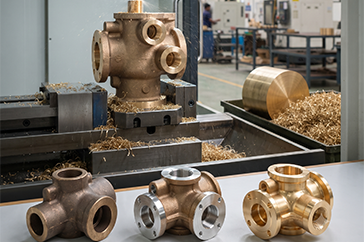
Brass casting whether sand casting, shell moulding or investment casting produces a near-net-shape blank that already contains the approximate geometry of the finished part.

The casting doesn’t need to become the part from scratch. It just needs to be finished.

The economics shift immediately:

Material utilisation improves dramatically. A cast blank for a complex valve body might require only 15-25% material removal during CNC machining versus 60-75% from the bar.

Less brass purchased. Less brass wasted. Lower raw material cost per finished component. Machine cycle time drops.

CNC machining time is directly proportional to the volume of material removed and the number of features generated from scratch.

A cast blank arrives with bosses, ports, and wall sections already formed.

The CNC machine refines and finishes; it doesn’t generate from nothing.

Cycle times on complex parts can be reduced by 40-60% compared to machining from a bar.

Complex internal geometry becomes feasible. Internal passages, non-concentric ports, and undercut features that would require multiple setups and special tooling to machine from bar can be cast into the blank as standard.

A brass casting with a pre-formed internal passage eliminates boring operations entirely on that feature.

Tool wear reduces. Continuous heavy cuts through large brass billets accelerate tool wear.

Lighter finishing passes on a cast blank extend tool life significantly reducing tooling cost per component across a production run.

When Cast-Then-Machine Is the Right Process

The decision depends on specific part characteristics:   Cast-then-machine is the right choice when:

  • Wall sections vary significantly across the part: thick bosses, thin walls, internal voids
  • The part has multiple ports, passages, or complex internal geometry
  • The finished component weighs more than approximately 300-400 grams
  • Production volume justifies casting tooling investment (typically 500+ pieces per run)
  • Material cost is a significant proportion of total component cost

 Machining from bar remains correct when:

  • The part is simple and rotationally symmetric, such as a straight turned component
  • The finished diameter is close to standard bar stock sizes, so material removal is minimal
  • Volume is too low to justify casting tooling
  • Lead time requirements don’t allow for casting procurement

The Brass Alloys Used in Cast-Then-Machine Components

 Not all brass alloys are suitable for casting. The alloy selection for a cast-then-machine component must consider both castability and machinability:  

  • C85500 / LG2 Gunmetal – excellent castability, good corrosion resistance, widely used for valve bodies and pump components
  • C86300 Manganese Bronze – high strength cast brass for load-bearing applications
  • C93200 / SAE 660 Bronze – centrifugal casting for bearing bushings and wear components
  • CW510L / CW509L – low-lead cast brass grades compliant with EU Drinking Water Directive positive lists for water contact fittings
  • C83600 good castability with balanced strength and corrosion resistance, commonly used for valves, flanges, and plumbing fittings
  • C84400 cost-effective casting alloy with good pressure tightness, used for low-pressure valves, pipe fittings, and general plumbing components

Alloy selection at the casting stage directly affects machinability, surface finish, and dimensional stability of the finished component.

A brass fittings manufacturer with genuine casting knowledge specifies the alloy to the application, not to what’s cheapest or most available.

How Amarex Metals Works Delivers Cast-Then-Machined Brass Components

Amarex Metals Works operates at the intersection of casting sourcing and precision CNC machining, which is exactly what cast-then-machine brass components require.

With manufacturing at Jamnagar, Amarex works with sand cast and shell moulded brass blanks.

Investment cast and die cast blanks are also within our scope. Every incoming casting is inspected against third-party test certificates from Government-approved NABL labs and spectroscopically verified before entering the CNC machining workflow.

Cast blanks are then CNC turned, VMC milled, bored, threaded and surface treated to final dimensional tolerances, producing finished brass machined components that meet export-grade specifications for buyers in the USA, UK, and Europe.

Final inspection uses VMM micron-level measurement systems.

Every shipment carries material documentation and, where required, RoHS and REACH compliance declarations.

For buyers sourcing complex brass fittings, valve bodies, pump components or multi-port manifolds, the cast-then-machine route delivers better economics, better cycle time, and better material utilisation than bar stock machining.

Amarex Metals Works is built to deliver that route, end to end.

Get a Quote