The Bar Stock Decision Is Costing You More Than You Think
When a buyer sends a drawing to a brass components manufacturer, the default assumption is often the same: machine it from bar stock.
Bar stock is available, familiar, and easy to quote. No tooling investment. No lead time for castings. Just load the bar, run the program, ship the parts.
For simple, small-diameter, low-complexity brass components that logic holds.
But for a significant category of brass parts (valve bodies, pump housings, complex fittings, multi-port manifolds, thick-section connectors), machining from bar stock is the wrong process.
It costs more, wastes more material, takes longer, and in some cases produces a structurally inferior component.
This article explains exactly when and why cast-then-machine beats machining-from-bar for brass parts and what that means for buyers sourcing brass fittings, brass machined components, and precision brass parts at volume.
The Core Problem With Machining Complex Brass Parts From Bar
Bar stock machining works by removing material from a solid billet until the finished shape remains.
For a simple turned component, a ferrule, a compression fitting body, a straight connector, the amount of material removed is manageable.
The process is efficient. But consider a valve body with multiple ports, a thick central boss, internal passages, and a complex external geometry.
To machine that from bar stock:
- The bar diameter must be large enough to encompass the largest cross-section of the part
- Every feature that isn’t the finished shape must be cut away as chips on the floor
- Machine cycle time scales with the volume of material removed, not the volume of the finished part
- Tool wear is higher when removing large volumes of brass continuously
- The finished component may have interrupted grain structure wherever significant material was removed
On a complex brass part, material removal rates of 60–75% are not uncommon when machining from a bar.
That means for every kilogram of finished component, 2.5 to 4 kg of brass bar was purchased, loaded, and turned into chips.
At current brass prices, that waste is not trivial and it compounds across a production run.
Why Casting First Changes the Economics Entirely
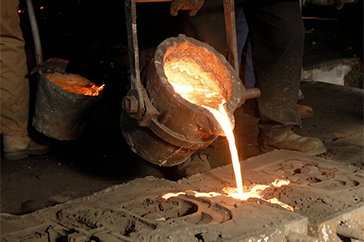
Brass casting whether sand casting, shell moulding or investment casting produces a near-net-shape blank that already contains the approximate geometry of the finished part.
The casting doesn’t need to become the part from scratch. It just needs to be finished.
The economics shift immediately:
Material utilisation improves dramatically. A cast blank for a complex valve body might require only 15-25% material removal during CNC machining versus 60-75% from the bar.
Less brass purchased. Less brass wasted. Lower raw material cost per finished component. Machine cycle time drops.
CNC machining time is directly proportional to the volume of material removed and the number of features generated from scratch.
A cast blank arrives with bosses, ports, and wall sections already formed.
The CNC machine refines and finishes; it doesn’t generate from nothing.
Cycle times on complex parts can be reduced by 40-60% compared to machining from a bar.
Complex internal geometry becomes feasible. Internal passages, non-concentric ports, and undercut features that would require multiple setups and special tooling to machine from bar can be cast into the blank as standard.
A brass casting with a pre-formed internal passage eliminates boring operations entirely on that feature.
Tool wear reduces. Continuous heavy cuts through large brass billets accelerate tool wear.
Lighter finishing passes on a cast blank extend tool life significantly reducing tooling cost per component across a production run.
When Cast-Then-Machine Is the Right Process
The decision depends on specific part characteristics: Cast-then-machine is the right choice when:
- Wall sections vary significantly across the part: thick bosses, thin walls, internal voids
- The part has multiple ports, passages, or complex internal geometry
- The finished component weighs more than approximately 300-400 grams
- Production volume justifies casting tooling investment (typically 500+ pieces per run)
- Material cost is a significant proportion of total component cost
Machining from bar remains correct when:
- The part is simple and rotationally symmetric, such as a straight turned component
- The finished diameter is close to standard bar stock sizes, so material removal is minimal
- Volume is too low to justify casting tooling
- Lead time requirements don’t allow for casting procurement
The Brass Alloys Used in Cast-Then-Machine Components
Not all brass alloys are suitable for casting. The alloy selection for a cast-then-machine component must consider both castability and machinability:
- C85500 / LG2 Gunmetal – excellent castability, good corrosion resistance, widely used for valve bodies and pump components
- C86300 Manganese Bronze – high strength cast brass for load-bearing applications
- C93200 / SAE 660 Bronze – centrifugal casting for bearing bushings and wear components
- CW510L / CW509L – low-lead cast brass grades compliant with EU Drinking Water Directive positive lists for water contact fittings
- C83600 – good castability with balanced strength and corrosion resistance, commonly used for valves, flanges, and plumbing fittings
- C84400 – cost-effective casting alloy with good pressure tightness, used for low-pressure valves, pipe fittings, and general plumbing components
Alloy selection at the casting stage directly affects machinability, surface finish, and dimensional stability of the finished component.
A brass fittings manufacturer with genuine casting knowledge specifies the alloy to the application, not to what’s cheapest or most available.
How Amarex Metals Works Delivers Cast-Then-Machined Brass Components
Amarex Metals Works operates at the intersection of casting sourcing and precision CNC machining, which is exactly what cast-then-machine brass components require.
With manufacturing at Jamnagar, Amarex works with sand cast and shell moulded brass blanks.
Investment cast and die cast blanks are also within our scope. Every incoming casting is inspected against third-party test certificates from Government-approved NABL labs and spectroscopically verified before entering the CNC machining workflow.
Cast blanks are then CNC turned, VMC milled, bored, threaded and surface treated to final dimensional tolerances, producing finished brass machined components that meet export-grade specifications for buyers in the USA, UK, and Europe.
Final inspection uses VMM micron-level measurement systems.
Every shipment carries material documentation and, where required, RoHS and REACH compliance declarations.
For buyers sourcing complex brass fittings, valve bodies, pump components or multi-port manifolds, the cast-then-machine route delivers better economics, better cycle time, and better material utilisation than bar stock machining.
Amarex Metals Works is built to deliver that route, end to end.
Author