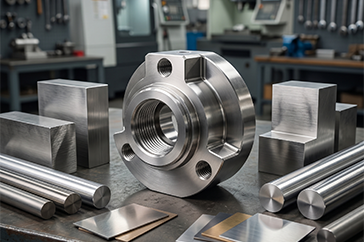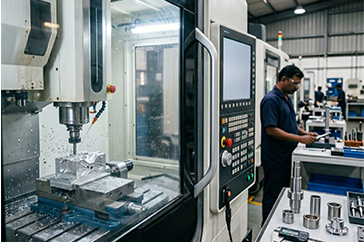
Two machines. One facility. Very different answers to very different problems.
When you’re specifying precision components, process selection isn’t a procurement detail, it’s an engineering decision that sits upstream of everything else.
Choose the wrong process and you’re not just adding cost. You’re building tolerance stack-ups, geometric non-conformances, and rework cycles into the job before the first cut is made.
Understanding the distinction between CNC turning and VMC milling isn’t academic. It’s the difference between a component that performs in service and one that causes problems on the assembly line.
What CNC Actually Means
CNC Computer Numerical Control is not a machine type. It’s a control methodology.
Any machine tool operating via G-code instructions qualifies: lathes, turning centres, grinders, and machining centres are all CNC in the sense that they execute programmed coordinates rather than relying on manual operator input.
What CNC control delivers, regardless of the machine it governs, is repeatability.
The program runs the same way on the hundredth part as it did on the first.
Dimensional accuracy is maintained across entire production batches without operator-to-operator variation.
Manual intervention is eliminated from the cutting process itself, and with it, the inconsistency that manual intervention inevitably introduces.
When engineers and buyers refer to CNC machining in the context of turned components, they’re typically referring to CNC turning, a process where the workpiece rotates against a stationary cutting tool to generate cylindrical geometry.
Diameters, bores, tapers, threads, undercuts, and grooves: these are the features that CNC turning produces with speed, accuracy, and efficiency.
Where CNC Turning Performs
CNC turning is the correct process for cylindrical and concentric geometries.
If your component has features that revolve around a central axis valve stem, pipe fittings, bushings, shafts, threaded bodies, CNC turning is the natural process choice.
The rotating workpiece generates those concentric features inherently, maintaining diametrical tolerances that would be far more difficult to achieve through any other method.
The process is fast, the setups are proven, and for the right geometry it delivers consistent, high-quality results at production volumes.
Trying to produce a turned component on a milling machine is possible in some cases, but it’s inefficient, and efficiency gaps in manufacturing translate directly into cost.
What a VMC Is and What It Does Differently
A Vertical Machining Centre is a CNC subtype so it shares the control methodology and the repeatability benefits.
The distinction is in its architecture. A VMC has a vertical spindle axis: the cutting tool points downward and moves in multiple axes across a workpiece that is clamped to the machine table.
This configuration opens up a fundamentally different class of geometry.
Where CNC turning revolves around a central axis, VMC milling works across prismatic surfaces: flat faces, pockets, slots, angled features, complex contoured profiles.
Multi-axis VMC machines can tilt and rotate the spindle or the table, allowing features at compound angles to be machined in a single setup without re-fixturing.
That last point carries significant engineering weight. Every time a component is re-fixtured moved from one setup to another, positional error accumulates.
Each setup introduces its own datum shift, its own clamping variation, its own contribution to the tolerance budget.
A VMC that machines multiple faces and features in a single setup eliminates those cumulative errors, which is why VMC processes deliver superior compliance on GD&T callouts for flatness, perpendicularity, angularity, and true position.
For components where geometric relationships between features matter where a bolt hole pattern must be perpendicular to a sealing face, or where an angular port must land within ±0.01mm of its nominal position VMC is not the preferred process.
It’s the required one.
The Cost of Getting It Wrong
Wrong process selection doesn’t fail loudly at the machine.
It fails quietly, downstream in assemblies that don’t close properly, in sealing faces that won’t seal, in positional tolerances that are out of spec on inspection.
By the time those failures surface, the machining is done, the components are finished, and the cost of correction is at its highest.
Specifying CNC turning for a prismatic component with tight geometric tolerances will produce parts that are dimensionally plausible but geometrically non-compliant.
Specifying VMC milling for a high-volume turned component adds unnecessary setup time and cost.
Neither outcome serves the application.
Right Process, Right Geometry: Amarex Metals Works
At Amarex Metals Works, a precision CNC machining and components manufacturer, process selection is part of the engineering conversation not an afterthought.
CNC turning and VMC milling operate within the same facility, across nine material families, under ISO 9001:2015 certification.
Every job is reviewed for the right process before programming begins, because the wrong choice at that stage costs time, money, and quality that no amount of downstream inspection recovers.
One facility. The right process for your geometry. Every time.
Author