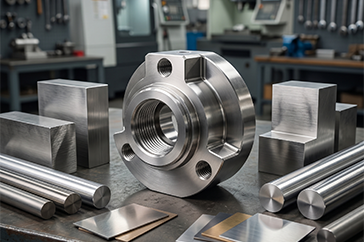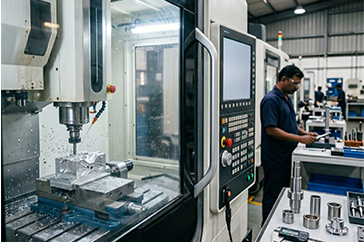
This is CNC machining and every micron of it is deliberate.
In a world where components are getting smaller, more complex, and more demanding, CNC machining remains the backbone of precision manufacturing.
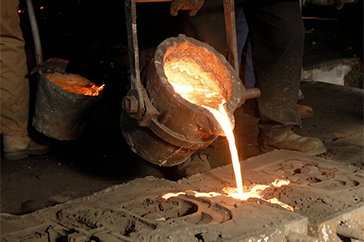
It’s a computer-controlled subtractive process: raw material whether bar stock, forged blank, or casting is loaded into the machine, and cutting tools remove everything that isn’t the finished part.
What remains is geometry defined not by human hands, but by code.
The Machine Reads. The Material Obeys.
At the heart of every CNC operation is G-code, a precise set of programmed coordinates that tells the spindle exactly where to move, how fast to cut, and how deep to go.
The machine doesn’t interpret or approximate. It executes.
Every bore, every thread, every facing pass is performed to a programmed specification, repeated identically across a run of hundreds or thousands of parts without drift, fatigue, or variation.
That repeatability is what separates CNC machining from manual operations.
A skilled machinist working manually will produce good parts.
A CNC machine running well-written code produces the same good part, to the same tolerance, at the same surface finish, on the ten-thousandth operation as it did on the first.
When your production line depends on components that fit, seal, and function identically every time, that consistency isn’t a nice-to-have; it’s the entire point.
Tolerances in modern CNC machining are routinely held to within micrometers.
For context, a human hair is roughly 70 micrometers in diameter. The dimensional accuracy being achieved on production components is a fraction of that consistently, across entire batches.
A Sequence That Cannot Be Shortcut
Precision machining doesn’t begin at the spindle.
It begins long before the first cut is made, with a process sequence designed to catch problems early, before they become expensive.
Design for Manufacturability review comes first.
DFM is the engineering conversation that happens before programming starts examining part geometry, tolerances, and material choices to identify anything that will cause difficulty in production.
A feature that looks straightforward on a drawing can be problematic to machines.
Identifying that before cutting begins saves time, material, and money.
Material verification follows. Bar stock and forged blanks are checked against specification before they enter the machine.
The wrong material, even if it looks identical, will behave differently under cutting forces and may not meet the mechanical requirements of the finished application.
CAM programming translates the part geometry into toolpaths.
Good CAM work considers not just the shape being produced, but the order of operations, the cutting strategy, the tooling selection, and the workholding approach.
It’s where machining time, surface finish, and tool life are all optimised before a single chip is made.
Machine setup fixturing, tooling, offsets, probing is where programming becomes reality.
A poorly set-up job will produce out-of-tolerance parts regardless of how well everything upstream was executed.
Setup is unglamorous work, but it determines everything that follows.
CNC turning handles cylindrical geometry: diameters, bores, threads, grooves, and profiles generated by rotating the workpiece against a stationary cutting tool.
Vertical Machining Centre milling handles prismatic features: pockets, slots, holes, and complex contoured surfaces produced by moving a rotating tool across a fixed workpiece.
Complex components often require both, in sequence.
Secondary operations deburring, tapping, broaching, grinding address features and finishes that primary machining can’t fully achieve.
Surface treatment follows: protective coatings, anodising, plating, or passivation depending on the material and the application environment.
Dimensional inspection closes the sequence.
Every critical feature is verified against drawing not sampled, not assumed before the component is approved.
CMM measurement, bore gauging, thread gauging, surface finish analysis: the inspection stage is where the entire upstream process is confirmed or rejected.
Every Stage Feeds the Next
That last point matters more than it might appear.
In a tightly sequenced process, a skipped or rushed step doesn’t just affect one part it propagates through the entire batch.
An unverified material goes through programming, setup, and machining before the problem surfaces.
An unreviewed geometry produces tooling interference at three in the morning.
A missed inspection releases non-conforming parts into a production line that’s counting on them.
The sequence exists because every stage in it is load-bearing.
Built to Spec: Amarex Metals Works
Amarex Metals Works, a precision CNC machining and components manufacturer, doesn’t shortcut that sequence.
Every job is planned through DFM, verified against material specification, programmed with intent, set up with care, machined to tolerance, finished to requirement, and inspected before it ships.
Across nine material families brass, steel, aluminium, Inconel, and more and under ISO 9001:2015 certification, Amarex Metals Works supplies precision-machined components to industrial buyers across the USA, UK, and Europe.
One spindle. The right process. Every time.
Author