Steel doesn’t just bend, it has to be forced.
That’s the brutal simplicity at the heart of forging, one of the oldest and most uncompromising manufacturing processes in modern industry.
While casting pours molten metal into a mould and hopes for the best, and machining carves a shape away from a solid block, forging does something fundamentally different.
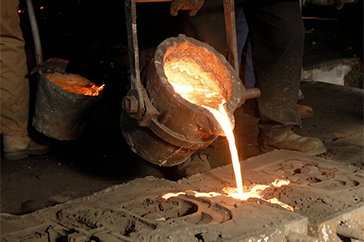
It takes a heated metal billet and compresses it under thousands of tonnes of pressure between precision-engineered dies, forcing the material to flow completely, obediently, into every contour of the cavity.
What comes out the other side isn’t just shaped. It’s transformed.
The Science Behind the Strength
When metal is worked under pressure at elevated temperatures, something remarkable happens at the microstructural level.
The internal grain structure of the material doesn’t just deform it realigns.
The grains flow with the shape of the part, wrapping around contours and following the geometry of the finished component rather than running in random directions as they would in a casting.
This grain alignment is everything. It’s the difference between a component that performs and one that merely exists.
Forged parts resist fatigue, handle impact loads, and tolerate cyclic stress in ways that cast alternatives simply cannot replicate.
Under repeated loading the kind that valves, pipe fittings, and locomotive components experience every day in service that aligned grain structure holds.
Castings develop internal porosity, shrinkage voids, and inconsistent density.
Forgings don’t.
This isn’t a marginal improvement. In critical applications, the difference between a forged component and a cast one can be the difference between a system that performs for decades and one that fails prematurely.
The Forging Sequence
Producing a forged component is a tightly controlled sequence of operations, where every step feeds into the next with precision.
It begins with the billet, a cut section of raw material prepared to an exact weight.
Not approximate. Exactly. Material volume directly determines how well the metal fills the die cavity, so a billet that’s even slightly off will produce flash in the wrong places or leave underfilled sections.
Weight control at this stage is non-negotiable.
The billet is then heated to a material-specific temperature.
Different alloys have different working windows too cold and the metal won’t flow, too hot and grain growth degrades properties. Getting that temperature right, and maintaining it consistently through to the press, is as much metallurgy as it is logistics.
At the press, the heated billet is placed between closed dies and compressed.
In that fraction of a second milliseconds of actual contact the metal fills the die cavity completely, the grain structure aligns, and the near-net shape of the finished component is formed.
The press force can reach 10,000 tonnes or beyond depending on the material and the part geometry.
Flash the thin fin of excess material that escapes at the die parting line is trimmed away in a separate operation.
The part then moves to heat treatment, where controlled heating and cooling cycles refine the microstructure further, relieving residual stresses and optimising mechanical properties for the intended application.
From there, it’s into the machine shop.
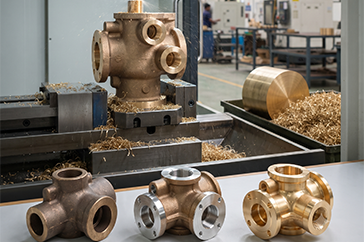
Forged blanks arrive close to final shape but still require CNC machining to achieve functional tolerances.
Sealing faces, thread forms, bore dimensions are machined to tight tolerances that the forging process alone can’t deliver.
Finally, inspection closes the loop: dimensional verification at the micron level, surface finish checks, and material certification ensure every component leaving the facility meets specification.
Where Forged Components Perform
The industries that rely on forged components are, almost without exception, the ones that cannot afford failure.
Oil and gas valves operate under extreme pressures in corrosive environments.
Pipe fittings in high-temperature process lines experience constant thermal cycling.
Automotive drivetrain components absorb shock loads repeatedly over hundreds of thousands of kilometres.
Locomotive parts run in continuous service under demanding mechanical conditions.
In all of these applications, the superior fatigue life and structural integrity of forgings justify their use.
Cast alternatives may be cheaper to produce, but over the lifetime of a system, the cost calculus shifts decisively in favour of forging fewer failures, less downtime, longer service intervals.
Built to Perform: Amarex Metals Works
Amarex Metals Works machines forged blanks across nine material families, including brass, steel, aluminium, Inconel, and a range of specialist alloys.
Operating under ISO 9001:2015 certification, Amarex Metals Works supplies industrial buyers across the USA, UK, and Europe delivering components that meet the dimensional, mechanical, and material requirements of demanding end-use environments.
Forging isn’t an easy process. It’s the right one.
Author