The Quote Looks Right. But Is the Supplier?
Sourcing precision components from an overseas machining manufacturer offers real advantages: competitive pricing, access to specialised manufacturing capability, and supply chain diversification.
But a wrong supplier decision doesn’t show up in the quote.
It shows up three months later, in a rejected batch, a missed production deadline, or a quality escape that reaches your end customer.
Buyers across the USA, UK, and Europe are increasingly qualifying CNC manufacturers in India particularly from precision manufacturing clusters like Jamnagar and Rajkot as primary suppliers, not backup options.
The capability is there.
The question is which precision machining companies are actually built to deliver at export grade, and which ones only appear to be.
The difference shows up quickly, across six areas that matter before a first purchase order is placed.
1. Quality Certification – and What It Actually Covers
ISO 9001:2015 certification is the baseline for any serious precision components manufacturer.
A certificate on a website means nothing without verification, the issuing body, the registration number, and the scope all need to be checked against the certifying agency’s public registry.
The scope is what most buyers miss.
An ISO certificate issued for general engineering may not cover the specific processes being bought: CNC turning, VMC milling, surface treatment, or special alloy machining.
The scope defines what the quality system actually governs and a supplier whose certificate doesn’t cover the relevant processes is not, in practice, a certified supplier for those processes.
2. Capability Statement, Not Just a Product Catalogue
A product catalogue shows what a supplier has made before.
What matters is what they can control: machine types, axis count, tolerance capability, material range, inspection equipment, and secondary process capability.
The strongest precision machine shops answer technical questions immediately and in detail tightest repeatable tolerance, inspection equipment in use, whether surface treatment is in-house.
Suppliers who respond to specific technical questions with generic brochures are showing you their ceiling before the first order is placed.
3. Material Traceability Documentation
Every precision machined component starts with raw material.
How a supplier verifies that material and what documentation they provide with each shipment is one of the clearest indicators of operational discipline.
The answer from a credible supplier includes: third-party test certificates from a Government-approved NABL lab, incoming inspection records, and spectroscopic verification of chemical composition.
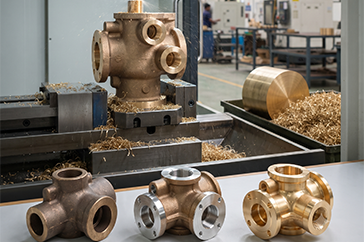
For buyers sourcing brass components, CNC turned parts, or special alloy machined components, a machining manufacturer who cannot provide material traceability documentation cannot guarantee what they’re machining or shipping.
Alloy substitution is one of the most common quality failures in offshore supply chains and it is invisible without traceability.
4. First Article Inspection Reports
Before committing to production volume, the standard practice among serious precision machining manufacturers globally is a sample order with a full First Article Inspection (FAI) report.
The FAI documents every critical dimension on the drawing: measured results against nominal values, with tolerances clearly shown, produced using calibrated inspection equipment.
A supplier who provides this without being asked is demonstrating process confidence.
A supplier who resists providing one is demonstrating the opposite.
5. Export Compliance Posture
For buyers in the USA, UK, and Europe, RoHS and REACH compliance declarations, certificates of origin, and full export documentation are not optional extras; they are part of the shipment.
A machining manufacturer with genuine export experience has these ready at the quoting stage.
One without that experience will tell you they can arrange it after the order is confirmed.
The correct question is not whether a supplier can provide compliance documentation.
It is whether they do so as standard, without being chased.
6. Communication and Response Quality
How a precision machining manufacturer communicates before the first order is a direct indicator of how they will communicate when something goes wrong during production.
Response time, technical accuracy, and willingness to engage with specific questions about processes all reveal operational maturity in a way that a capability brochure cannot.
How Amarex Metals Works Performs Across All Six
Every point on this list is something Amarex Metals Works addresses as standard practice not on request, and not after the first order has been placed.
ISO 9001:2015 certification is held at our Mumbai head office, covering documented quality procedures across CNC turning, VMC milling, and precision engineering services.
Material traceability runs from incoming inspection to finished component: every material lot is spectroscopically verified on arrival, backed by third-party test certificates from Government-approved NABL labs.
First Article Inspection reports are produced on every new job using VMM micron-level measurement systems.
RoHS and REACH compliance documentation is confirmed at the quoting stage for buyers in the USA, UK, and European markets.
With manufacturing at Jamnagar at the centre of India’s precision manufacturing export belt and head office in Mumbai, Amarex supplies precision machined components across brass, steel, aluminium, stainless, and special alloys to auto components manufacturers, valve and pipe fitting buyers, brass parts suppliers, electrical equipment builders, and marine hardware buyers across 14 industries globally.
The first purchase order with a new overseas supplier carries real risk.
Amarex Metals Works is built to reduce it with process documentation, inspection records, and export compliance that give buyers the confidence to convert a sample order into a long-term supply relationship.
Author